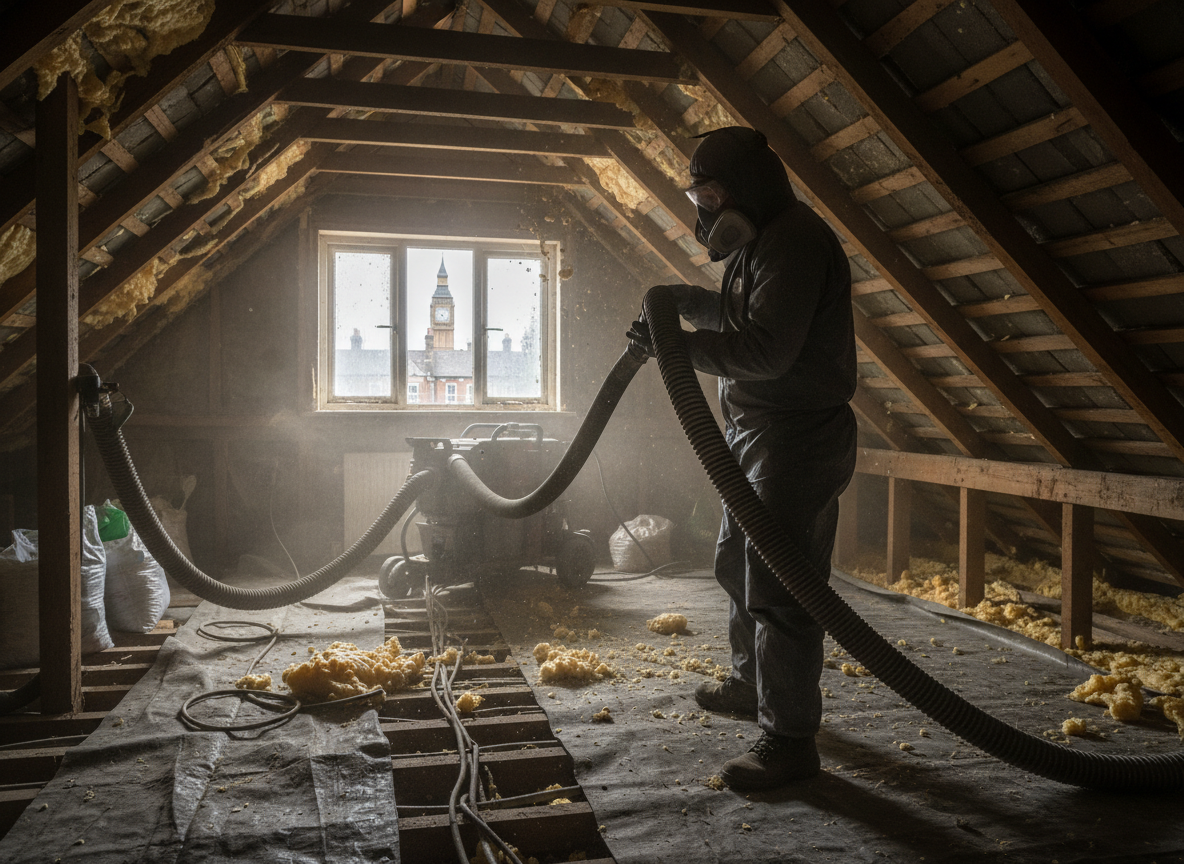
London’s Victorian and Edwardian terraces often received spray foam decades after construction, sealing breathable brick and lime mortar behind impermeable layers. Once winter temperatures drop and rain persists through autumn, condensation builds against joists and wall plates, leading to wet rot that spreads along shared party walls in terraces from Hackney to Islington. Removal crews must cut access hatches without disturbing original lath and plaster ceilings, then extract the foam in sections to avoid dropping debris into habitable rooms below.
Closed-cell foam bonds tightly to rafters and underfelt in London lofts, requiring oscillating blades and careful heat application to release it without scorching timber. Open-cell foam, more common in 1990s extensions across Greater London, crumbles into fine dust that settles into floor voids and must be vacuumed with HEPA filtration to prevent it migrating through floorboards into downstairs spaces. Disposal follows Environment Agency rules for construction waste, with loads taken to licensed sites rather than general landfill.
Homeowners frequently discover the foam was applied over existing mineral wool or between ceiling joists without ventilation gaps, a common shortcut in conversions from the 2000s. Removing it restores airflow but leaves gaps that need temporary boarding until new insulation is chosen. Work is scheduled around the city’s narrow access streets, with equipment carried through front doors in areas like Camden and Southwark where rear access is blocked by garden walls.
Technician insight
In London, the thing that catches most people out with spray foam insulation removal is how quickly moisture trapped behind closed-cell foam rots the ends of ceiling joists in pre-1919 terraces where the original underfelt has already failed.
Loft Clearance In A Hackney Terrace
The owner reported musty smells in the master bedroom below the loft. Inspection showed closed-cell foam had sealed over failed roofing felt, allowing water to pool against joist ends. We removed the foam in sections, cleared the debris, and opened the eaves for airflow, stopping further rot without disturbing the original lath ceiling.
How it works
- 1
Initial Survey
Inspect loft and wall cavities in the London property, identify foam type, check for timber decay, and note access constraints typical of terraced housing.
- 2
Containment And Protection
Seal rooms below, lay dust sheets, and set up negative air units to stop foam particles spreading through the shared walls common in Greater London terraces.
- 3
Foam Extraction
Cut and peel foam from rafters and brickwork using hand tools and heat where needed, working around original timbers without causing further damage.
- 4
Clearance And Disposal
Vacuum residues, remove all waste to licensed sites, and leave the space ready for inspection or new ventilation measures.
Pricing
Cost depends on access, foam depth, and property layout; quotes provided after survey.