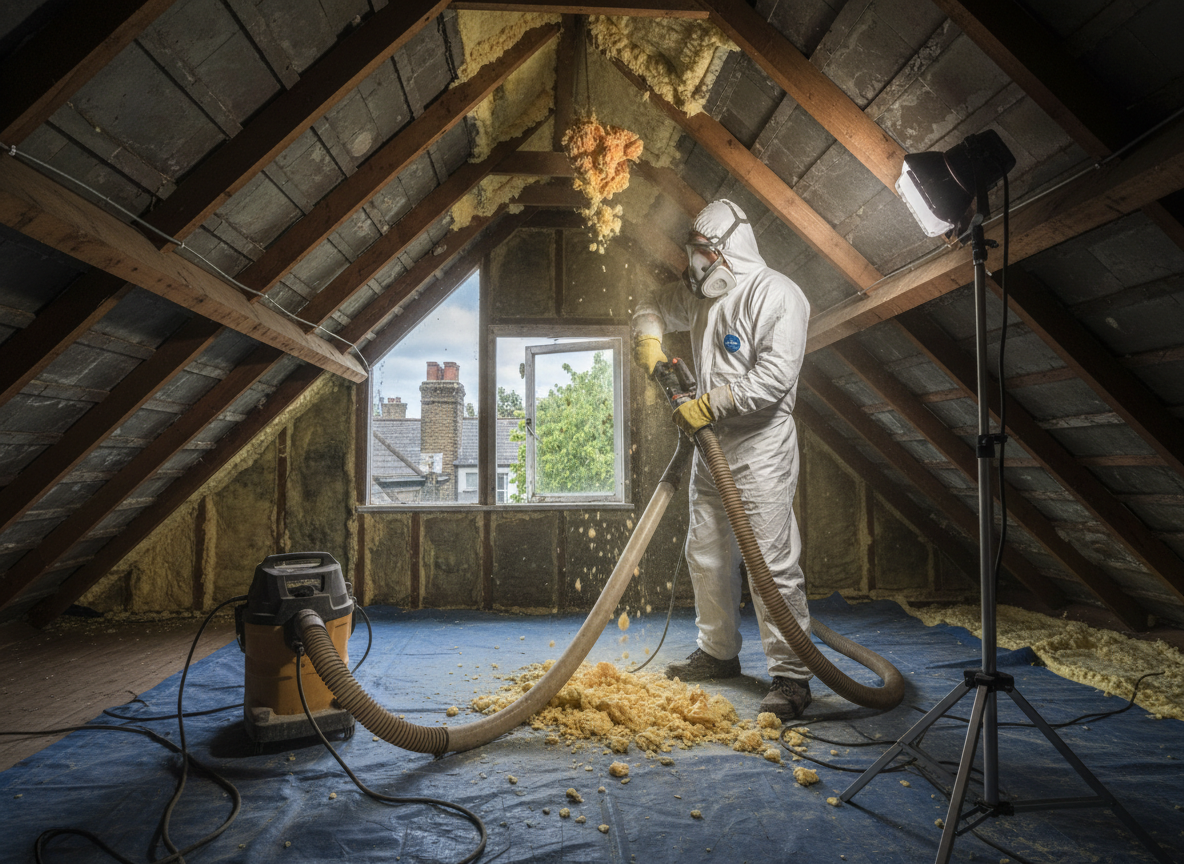
London’s older housing stock, especially Victorian and Edwardian terraces in boroughs such as Islington and Hackney, often contains spray foam applied directly to lath-and-plaster ceilings or under pitched roofs. Over time the foam can trap moisture against timber joists, leading to rot that only becomes visible once the material is cut away. Removal crews must work in confined lofts with limited headroom, using hand tools and low-dust vacuum systems to avoid collapsing fragile ceilings below.
Closed-cell foam bonds aggressively to brickwork and felt, while open-cell types crumble into fine particles that drift through floorboards into living spaces. Both require staged containment with plastic sheeting and negative-air machines to protect residents. Disposal follows Environment Agency rules for construction waste; loads are bagged on site and taken to licensed transfer stations rather than mixed with household refuse.
Weather in the London area adds another layer: winter jobs demand extra tarpaulins to keep rain off exposed roof voids, while summer heat softens some foams and changes how they release from joists. Every project begins with a torch-and-probe inspection to map foam depth and any hidden electrical or pipework runs before cutting starts.
Technician insight
In London, the thing that catches most people out with Residential Spray Foam Removal is how readily the foam bonds to the thin laths in Victorian ceilings around areas like Camden and Southwark; one wrong pull and you drop plaster into the room below, turning a simple extraction into a full ceiling repair.
1930s Terrace in Hackney
Homeowner reported damp patches on bedroom ceilings after previous foam install. Inspection showed closed-cell foam trapping condensation against the rafters. We sectioned the material with oscillating tools, vacuumed the residue and restored airflow through the eaves without disturbing the original plasterwork.
How it works
- 1
Site Inspection
Assess foam type, depth, access routes and any structural concerns in the London property.
- 2
Containment Setup
Install sheeting, floor protection and dust extraction to keep the rest of the home clean.
- 3
Foam Extraction
Cut and remove material in sections using hand tools and vacuums suited to the roof void layout.
- 4
Cleanup And Disposal
Vacuum residues, bag waste and remove all equipment before final walkthrough.
Pricing
Upfront quotes provided after inspection; cost varies with property age, foam depth and loft access.