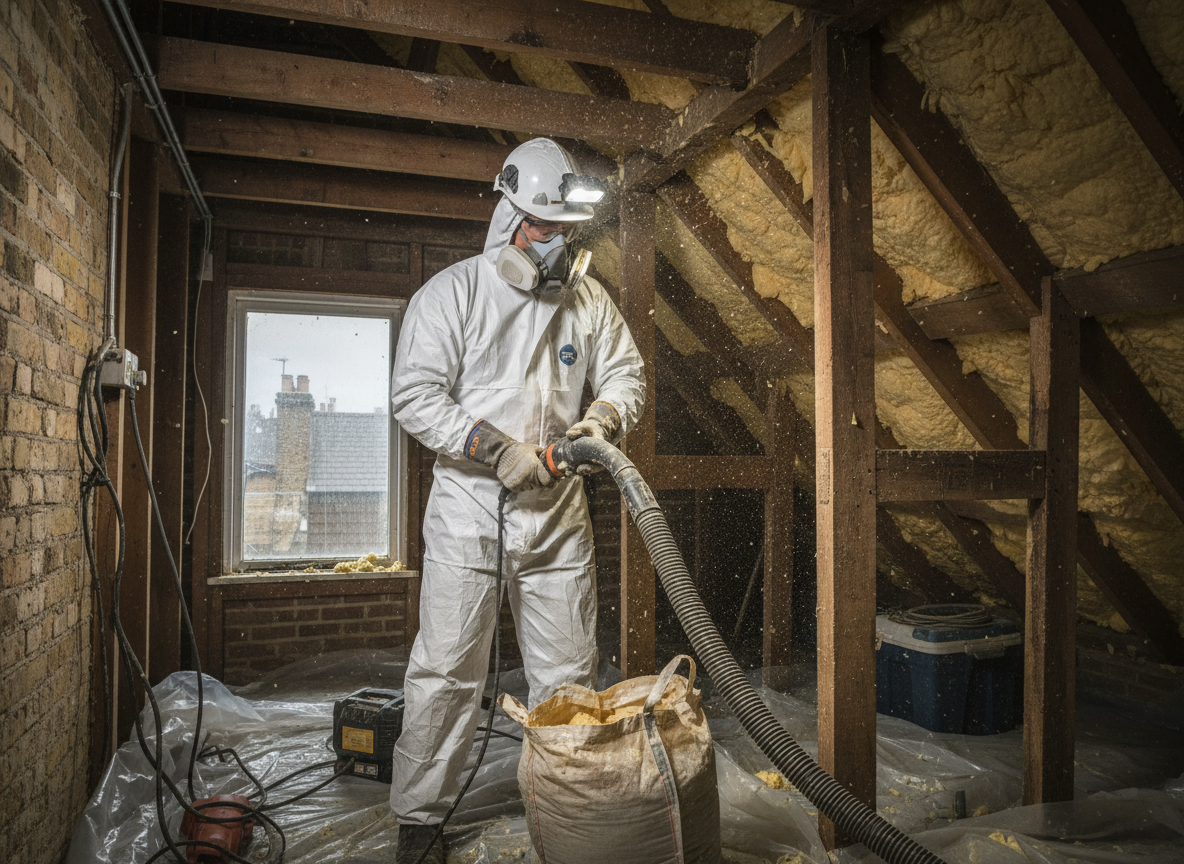
London's housing stock is dominated by Victorian and Edwardian terraces with slate roofs and narrow lofts that were never designed for modern insulation. Spray foam applied directly to the underside of these roofs often seals in damp, leading to timber rot along rafters and shared party walls that run between properties. Removal requires cutting the foam in controlled sections rather than pulling it away in large sheets, because sudden force can crack fragile lathe-and-plaster ceilings below. The city's frequent rainfall and high humidity mean any remaining foam residue quickly re-absorbs moisture, so thorough vacuuming and surface cleaning are essential before ventilation can be restored.
Polyurethane spray foam bonds aggressively to timber, felt and brickwork. In central London terraces the foam frequently extends into eaves and behind chimney breasts, creating hidden pockets that must be located with inspection cameras. Workers use oscillating blades and handheld scrapers to separate the material without damaging the original roof structure. Once the bulk is removed, residual cells are dissolved with approved solvents that do not affect the underlying timber. Dust and off-gassing are contained with negative-pressure setups because many jobs are in occupied homes where residents remain downstairs.
UK building regulations now discourage closed-cell foam in roof voids without proper ventilation paths. Homeowners in areas such as Islington and Hackney often discover the foam was installed without the required breathable membrane, leaving rafters vulnerable once the foam is stripped. After removal, temporary ridge and eaves ventilation is installed to allow the roof to dry before any new insulation is considered. Skipping this drying period in London's damp climate commonly results in recurring mould within months.
Technician insight
In London, the thing that catches most people out with loft spray foam removal is how Victorian terraces share party walls that run straight through the loft space. Foam often bridges into the neighbour's side, so one wrong cut can disturb someone else's ceiling or release dust into their home.
Clapham Terrace Loft
Homeowner reported musty smells and stained ceilings. Inspection showed closed-cell foam had sealed against the slate roof and extended across the party wall. The foam was cut away in sections, residual cells were cleaned, and ridge ventilation was added. The roof timbers dried without further rot.
How it works
- 1
Site Survey and Moisture Check
Technicians inspect the loft, map foam coverage, test timber moisture levels and identify access constraints typical of London terraces.
- 2
Containment and Dust Control
Negative-pressure barriers and floor protection are set up to keep debris out of living areas below.
- 3
Sectional Foam Removal
Foam is cut and lifted in manageable pieces using oscillating tools, with care taken around shared walls and chimney stacks.
- 4
Surface Cleaning and Ventilation
Residual material is removed, timbers are cleaned, and temporary ventilation is installed to begin drying.
Pricing
Pricing varies by loft size, foam depth and access difficulty; an inspection provides an upfront quote.